
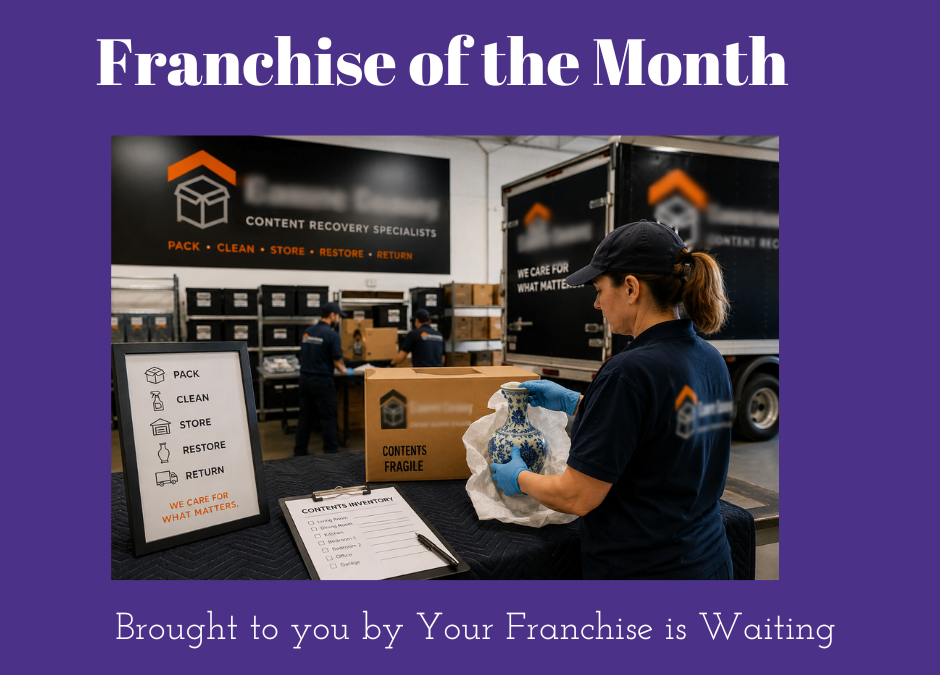
Some of the most interesting franchise opportunities aren’t businesses you see on every street corner. They’re the businesses operating behind the scenes in large, established industries—solving problems most consumers never realize exist.
This month’s Franchise of the Month is a great example.
This franchise operates within the $210 billion insurance restoration industry, but it isn’t a traditional restoration company. Instead, it specializes in one very specific—and increasingly important—piece of the insurance claims process: recovering, cleaning, documenting, and securely storing the contents of a home or business following a property loss.
Think about what happens after a fire, flood or other major property claim.
Before contractors can begin rebuilding a property, furniture, artwork, clothing, electronics, family heirlooms and hundreds—sometimes thousands—of other belongings may need to be carefully inventoried, removed, cleaned, restored and stored.
Historically, that work has often fallen to restoration contractors whose skilled employees are better utilized rebuilding the property.
This franchise was created to specialize in that overlooked part of the process.
Why We, Like This Business Model
It’s B2B rather than consumer-driven.
Franchise owners build relationships with restoration contractors, insurance companies, adjusters and other industry partners who can become ongoing referral sources. You’re not relying on homeowners deciding whether they feel like purchasing your service.
The insurance company pays the bill.
Revenue comes from insurance claims rather than discretionary consumer spending. The model uses insurance-industry estimating systems, and corporate provides an estimate-review process before invoices are submitted to the carrier.
It solves a real problem for restoration companies.
Restoration contractors need to get damaged properties rebuilt quickly. Having their highly paid carpenters and skilled labor packing boxes, cataloging belongings and managing storage isn’t necessarily the best use of those employees.
A specialized contents company allows the contractor to concentrate on restoration while another professional team manages the belongings.
There’s an interesting recurring-revenue component.
Once contents are removed from a property, they may need to remain in storage for weeks—or even many months—while reconstruction is completed. That means a single project can continue generating storage revenue long after the initial pack-out is finished.
It’s a specialized niche within a very large industry.
Rather than competing as another general restoration contractor, this business focuses specifically on contents. That’s what makes the opportunity particularly interesting to me: it occupies a defined specialty within an already established insurance ecosystem.
What Does the Owner Actually Do?
This is very much a relationship and business-development business.
The ideal owner is comfortable networking with restoration contractors, project managers, insurance professionals and commercial partners and developing the referral relationships that generate jobs.
As the business grows, the owner builds a team to handle the operational side of packing, inventorying, cleaning, restoring and storing customers’ belongings.
Technology is also an important part of the model. Items are digitally inventoried and tracked, creating a searchable record of what was removed, where it is stored and ultimately where it needs to go when the property is ready.
Could This Be Semi-Absentee?
Potentially, yes.
The franchise is designated as offering a semi-absentee ownership model, although I would definitely ,not describe this as a passive investment.
An owner still needs to drive relationships, oversee the business and make sure the team executes well. The franchisor’s profile for an owner specifically calls for someone who can dedicate approximately 20 daytime hours per week with flexibility.
For the right executive, however, that can make this an interesting option for building a business without necessarily leaving a corporate position on Day One.
Training and Support
One of the things I look closely at with an operationally specialized franchise is whether you’re expected to arrive already knowing the industry.
Here, the franchisor provides a fairly extensive support structure that includes:
- Initial training and on-the-job training
- On-site training at the franchisee’s location
- Networking and business-development training
- Ongoing business coaching
- Marketing and SEO assistance
- Estimate and invoice review
- Assistance with complex insurance claims
The company also has established relationships within the restoration and insurance industries that can help franchisees build credibility and develop their local markets.
Investment
For a single territory, the current estimated total investment is approximately:
$201,300–$422,700
Additional financial qualifications include:
Required liquid capital: $150,000
Minimum net worth: $1 million
The business is not home-based and requires a facility because storage is an integral part of the model. The materials indicate an average of approximately two employees, making this relatively lean compared with many businesses in the broader restoration category.
Who Might Be a Good Fit?
I think this opportunity is particularly interesting for someone who:
- Enjoys B2B relationship building and networking
- Is comfortable working with contractors and other business professionals
- Wants an essential-service business rather than one dependent on consumer trends
- Likes the idea of building a team rather than personally performing the service
- Is looking for an opportunity with multi-territory growth potential
- Wants a business with a tangible, understandable value proposition
And there’s another component I like: you’re helping people during a very difficult moment.
After a major property loss, the building can often be repaired. But some of the things inside it can’t simply be replaced. A well-run contents recovery business can help preserve photographs, heirlooms, artwork and other belongings that may have tremendous sentimental value to the homeowner.
That creates an unusual combination: a B2B, insurance-driven business with a very human end customer.
Want to Know Which Franchise It Is?
As always, I’m intentionally not naming this month’s featured franchise here. And, in this case, there are a few different franchises in the space so if territory isn’t available for one, we can check the others.
There is much more to evaluate—including the Item 19 financial performance information, territory availability, owner validation and whether the model makes sense in your particular market.
If you’d like the name of the franchise and the additional financial and franchise information, contact me, and I’ll send you the details.